@Global view of transcriptome in the brains of aged NR2B transgenic mice (Li et al. 2013)
2022-04-12: reference:
- Genetic Enhancement of Memory and Long-Term Potentiation but Not CA1 Long-Term Depression in NR2B Transgenic Rats
- Young receptors make smart mice
@Global view of transcriptome in the brains of aged NR2B transgenic mice (Li et al., 2013) #
“Doogie mice” are those with enhanced LTP, learning, etc. - in this sense it’s frequently due to NR2B transgenicity.
-
Developing cortical synapses also dominated by a low AMPAR/NMDAR ratio, due to this higher ratio of NR2B:NR2A.
- A high A:N ratio actually implies greater NMDA activity, which leads to: decreased Protein Kinase B and ERK signalling, inhibiting mTOR, leading to dendrite atrophy and decreased synaptogenesis.
- The decrease in B:A = decrease in NMDA’s EPSP - and increase in threshold (meaning it’s more difficult/shorter) for synaptic plasticity induction.
-
Genetic enhancement of learning and memory in mice (1999)
- Enhanced signal detection by NMDA receptors should enhance learning and memory. Here we show that overexpression of NMDA receptor 2B (NR2B) in the forebrains of transgenic mice leads to enhanced activation of NMDA receptors, facilitating synaptic potentiation in response to stimulation at 10-100 Hz. These mice exhibit superior ability in learning and memory in various behavioural tasks, showing that NR2B is critical in gating the age-dependent threshold for plasticity and memory formation.
-
- Several lines of evidence have suggested that brain-derived neurotrophic factor (BDNF) is an attractive candidate mediator that is implicated in NR2C upregulation in developing (Cerebellum) Granule Cells.
- We examined the specificity of mRNA induction for the NMDA receptor family after treatment with BDNF. BDNF slightly upregulated NR1 mRNA, but the extent of this upregulation was much lower than that of NR2C mRNA (Fig. 2A). No such induction was observed for NR2A or NR2B mRNA:
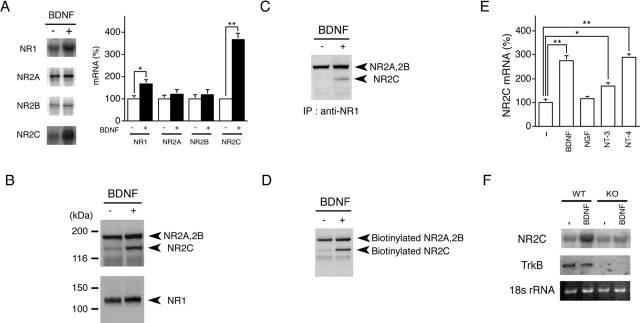
- 50ng/mL each. It’s still upregulation, but in net terms, NR2B is outcompeted by NR2C heavily.
- We examined the specificity of mRNA induction for the NMDA receptor family after treatment with BDNF. BDNF slightly upregulated NR1 mRNA, but the extent of this upregulation was much lower than that of NR2C mRNA (Fig. 2A). No such induction was observed for NR2A or NR2B mRNA:
- Several lines of evidence have suggested that brain-derived neurotrophic factor (BDNF) is an attractive candidate mediator that is implicated in NR2C upregulation in developing (Cerebellum) Granule Cells.
-
This looks fire: NR2B subunit in the prefrontal cortex: A double-edged sword for working memory function and psychiatric disorders (2016)
- Because of its slow kinetics, NR2B endows the PFC with not only “neural psychic” properties, but also susceptibilities for neuroexcitotoxicity and psychiatric disorders.
- PSYCHIC? Refuses to elaborate.
- Because of its slow kinetics, NR2B endows the PFC with not only “neural psychic” properties, but also susceptibilities for neuroexcitotoxicity and psychiatric disorders.