
The Experience
This is probably the best introduction to meditation of all time.
So Jhourney is a company that offers 7-day meditation retreats both residential and online. Part of their namesake is of course the jhanas1; teaching these states is the core of their identity. However, their real, secret goal, which I think they succeed at: learn how to teach yourself how to make meditation enjoyable.
Why did I do this? I myself was already “experienced in meditation”. But in this 5-year quest for enlightenment characterized by striving for attainments, insights, confirmation… the issue here was obvious. The right path is good in the beginning, good in the middle, and good in the end. Here I was, not really enjoying meditation. Going into this, I’d been on 3 10-day Goenka retreats and an 80-day Mahasi retreat in Malaysia. Looking for any fruits of my labor, visible here and now, I found myself unsure if I anything was there; I knew I needed a more open and emotional approach after trying the whole “dry insight” thing. The art of wellbeing, I have learned recently on a much more profound level, is one of the most precious things available to humanity.
So a solid amount of Jhourney’s practice instructions and core concepts thereof are publicly available on YouTube and on their website, blog, etc. If you’re really self-motivated, you can give it a try, but there’s definitely a lot of nuance that is captured on retreat and in their broader curriculum (~120 pages worth?) and in your 1-on-1 interviews. I’d recommend probably just diving into a retreat. The entire point is that the instructions/“technique” is a bit personalized, so I must admit there’s really not a whole lot I feel comfortable saying without gradually easing into these things; they’ve put so much work into how they precisely word and present the instructions and, again, how it ultimately boils down to your experience.
Triangulation is a key idea in their instructions - words are just pointers; you might find something better that works for you. Even instructions are just pointers - you might find mental moves that work better for you. Indeed: together with the very idea of recursion, which they also emphasize, I think triangulation is a key principle through which the entire “idea” behind Jhourney’s teachings can be read. They do not prescribe a “right way” of doing things; they only push you in a certain direction to let you see for yourself what works. We trust our own experience, and we forge our own path. This is something they explicitly state: they do not aim to “teach the jhanas”, but to “teach you how to teach yourself the jhanas”. This is, of course, an immensely more valuable skill: “teach a man to fish, and he’ll feed himself for a lifetime”, as they say.
In essence, however: the ‘basic technique’ is just bringing up your scaffolding—a TWIM-style mantra, a happy memory, maybe just smiling—to evoke the openhearted feeling, periodically pulsing it gently - not spamming it - as you learn deeper and deeper ways to appreciate/be curious about the openhearted feeling. This feeling is bound to grow, expand, or otherwise intensify. Eventually, your concentration collectedness/sense of unification around this feeling will begin to take on a life of its own and become metastable, seemingly increasing by simply paying attention to it. Things will exponentially intensify if you keep at it with the same mental factors2 that got you there—not clinging to the experience, nor running away—and before you know it, you have entered jhana. Or—as they sometimes say—jhana has entered you.
Jhourneying is a type of meditation you get introduced to after a few days. That’s their name for what is basically a 1-on-1 guided meditation, where you give feedback on what you’re experiencing every few minutes or so. Either a facilitator does this - or - at any time during your solo sit timeblocks you can use their recently-made AI Jhourneying bot, which exists as part of their ‘app’ (which also includes an LLM chatbot - both are trained on the instructions. There are some other things as well, but I only used the Jhourneying bot.) which I quite enjoyed! (The bot is speech recognition + TTS so you don’t have to type or anything like that).
When Jhourneying, the first thing the facilitator/AI will ask you is something to the effect of “what is present in your experience now”? and you might say something like “a warmth in my chest”, “a feeling of tension in my head”, “this sparkling light flowing throughout my body”. The first question or 2 might be a mostly random selection, asking about a basic property like texture, size, temperature, emotional quality, location, etc. Then, things will gradually progress into deep territory.
I consistently had a pretty good time both with the facilitators and the AI; I dare say they’re about equal: with the AI you don’t feel pressured about having social grace like respectfully replying in a timely manner (the human facilitators will just check up every 5 minutes if you don’t reply, and I’ll assume probably drop off if you don’t reply after a long time, since you’re probably in jhana) so as not to waste their time; with the AI you can just cruise on an instruction for tens of minutes—hours if you’d like—and drop the back-and-forth. Not that an understanding facilitator wouldn’t accommodate that, but there is that subtle tension of wanting to be “respectful” or whatever anyways. But the thing human facilitators excel at is that they definitely take more care in grasping this overarching meta-narrative throughout the entire sit, so to say—they seem to ask really intentional, thoughtful questions, like they’re trying very hard to simulate in their minds your phenomenology based on your word choice, tone, and based on your proclivities they’ve come to known from prior sessions/interviews. Not that the AI is starting fresh every question or anything—it has a decent sense of continuity and thoughtfully pushes you in certain directions. The human facilitators are just better at all that.
In essence though, as far as I can see it, the idea behind it all is blindsiding you with questions you’d never ask about how you can look at what you’re experiencing - locate it, appreciate it, accept it, open up or narrow down your sense of awareness, etc. You can usually consider the suggestions as ’experiments’ to run and see what happens.
Constant experiment is a very important part of Jhourney’s methodology in every sit, Jhourneying or otherwise. Having a hypothesis—“what if I drop my effort by 10x next sit/for the next 10 minutes?”, “what happens to this feeling of heaviness in my body right now if I imagine that I’m floating in the sky?"—and seeing the result. If the result is good, then perhaps you should start incorporating it. Jhourneying just has someone ask the questions for you. And sometimes, it’s exactly what you needed, and it might quickly take you into some crazy territory. For example, on days 3-4 I got pretty close to entering J3/4 (more on that topic later…) with Jhourneying.
Or, for example: one of the most interesting/shareable Jhourneying experiences was the only big emotional (release) experience I had on the retreat - with the AI bot no less. Starting the sit, the most prominent sensation was this restless, impatient desire of “wanting things to progress/get interesting” or something like that. The AI then asked me, “what does that impatience want to feel right now?” which is something I would probably never ask myself. And almost immediately, I could viscerally feel this profound pity towards these thoughts/“distractions”, like they were a neglected child, only just trying to help. “They just want to feel loved…” I replied. I extended my compassion to each thought that manifested in my mind, as I watched them dissolve into the void one by one as tears fell down from my eyes.
There was this very liberating sense of disidentification. Especially with the shorter, more emotional ‘pings’ (as opposed to the longer-duration ’trains of thought’) they were objectively observable from an outside perspective. It felt like I was penetrating into my unconscious mind, and little “engrams” - not necessarily fully-formed memories or anything - silhouettes of what I can only assume are past experiences; built up ‘priors’ or what have you… ’traumas’, perhaps—who knows: the more memories I released, the ‘deeper’ I seemed to go as associated ideas I’ve never experienced before popped out of nowhere, little by little, re-experiencing them in a way3.
I wouldn’t go so far as to call their approach a paradigm shift of meditation pedagogy, but if the pattern continues at a similar pace for a few years, I think they’re on track. As a fellow retreatant described during the closing session (discussing some things we appreciated about the retreat, or something like that), Jhourney in 2023 was basically “TWIM without Pali for tech bros”4, whereas now their experience in 2026 was totally different. Jhourney basically iteratively improves itself, retreat after retreat, recording just about everything and asking for massive amounts of feedback after the retreat, and a decent amount during the retreat (weaving relatively seamlessly with journaling for one’s own sake). They truly seem to be trying to discover the principles from which jhanas arise and how they can teach them such that they become as accessible as possible. If the impression you got from that initial goal was expecting some dispassionate mechanical prescription, I hope by now I have illustrated how it is far from it; precisely the opposite.
The atmosphere of openness and experiment is something I’ve never experienced before on a meditation retreat, and nothing I’ve really heard of much. I didn’t expect myself to care about this, like maybe even at all, but wow - the sense of community was also nice. Everyone seemed to be sincere and serious like they were really trying to figure this thing out. The facilitators were also amazing. They often seemed to be more “fellow explorers” if you will than “teachers”. It is a bit hard to convey the benefits of this frame shift, but it was absolutely there. So yeah, looking back, it definitely all gave me a sense of security, safety, belonging, and other cozy emotions like that which keep the jhanic factors healthy. The late-night sits were pretty epic (e.g. Day 2).
So yeah, the online format was really not an impediment in this regard, which also surprised me. They do claim on their FAQ and in a blog post that their success rate for online and in-person is almost identical… albeit slightly higher for in-person retreats. But it is as they say - in-person retreats have a tight feeling of community, while for the remote retreats, there is something nice about being totally isolated at times… but then again, I learned to enjoy always being in the meditation hall at Goenka retreats. Keeps you concentrated. But between the morning and evening sessions are the daily 1-on-1s (for me, anyways - I volunteered for a lot of Jhourneying sessions. The default 1-on-1s aren’t always daily afaik) and the consistent reading of instructions, guided meditations, etc. certainly kept me in the “retreat bubble” despite (or maybe because?) being on my laptop all the time.
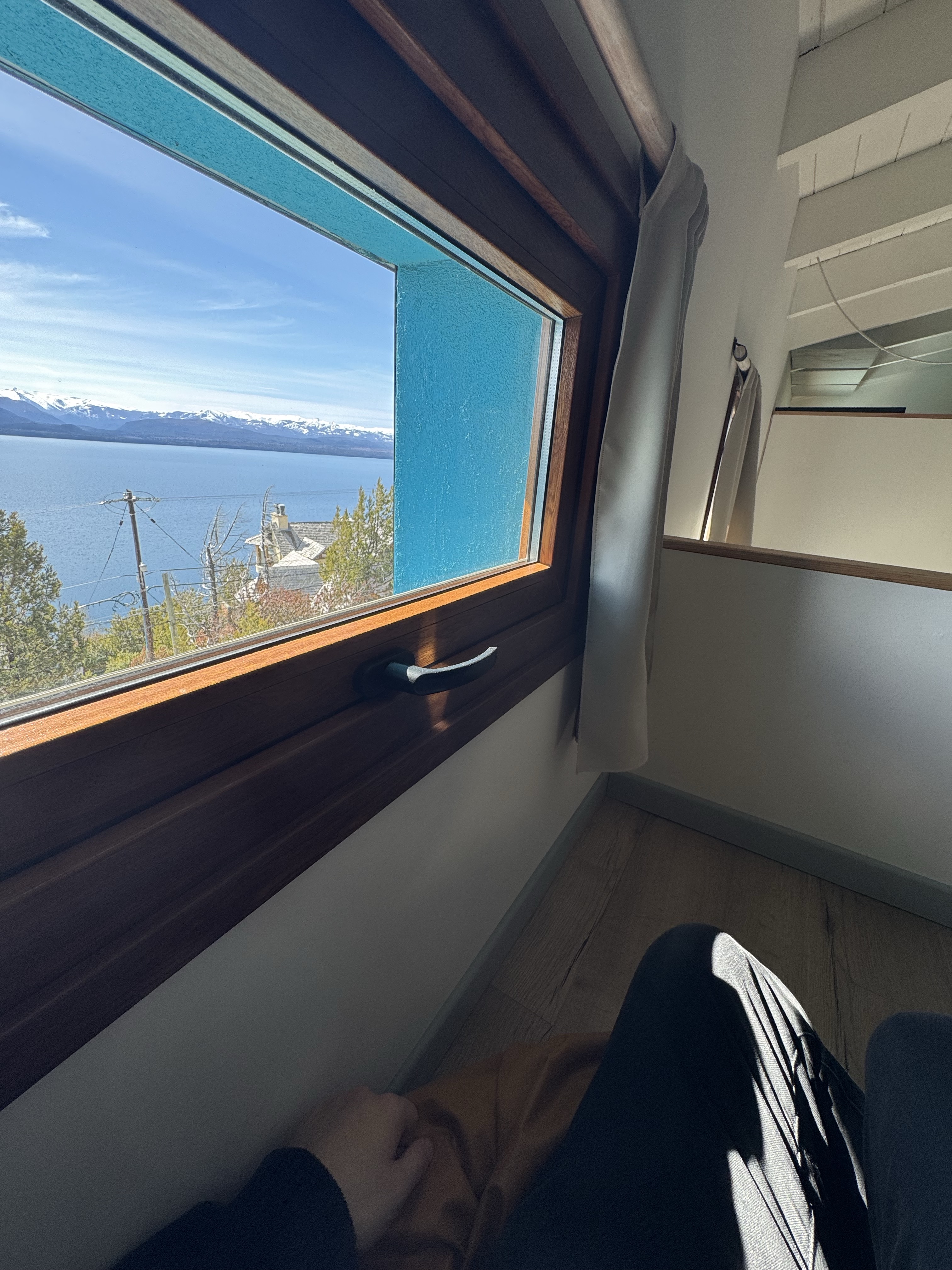
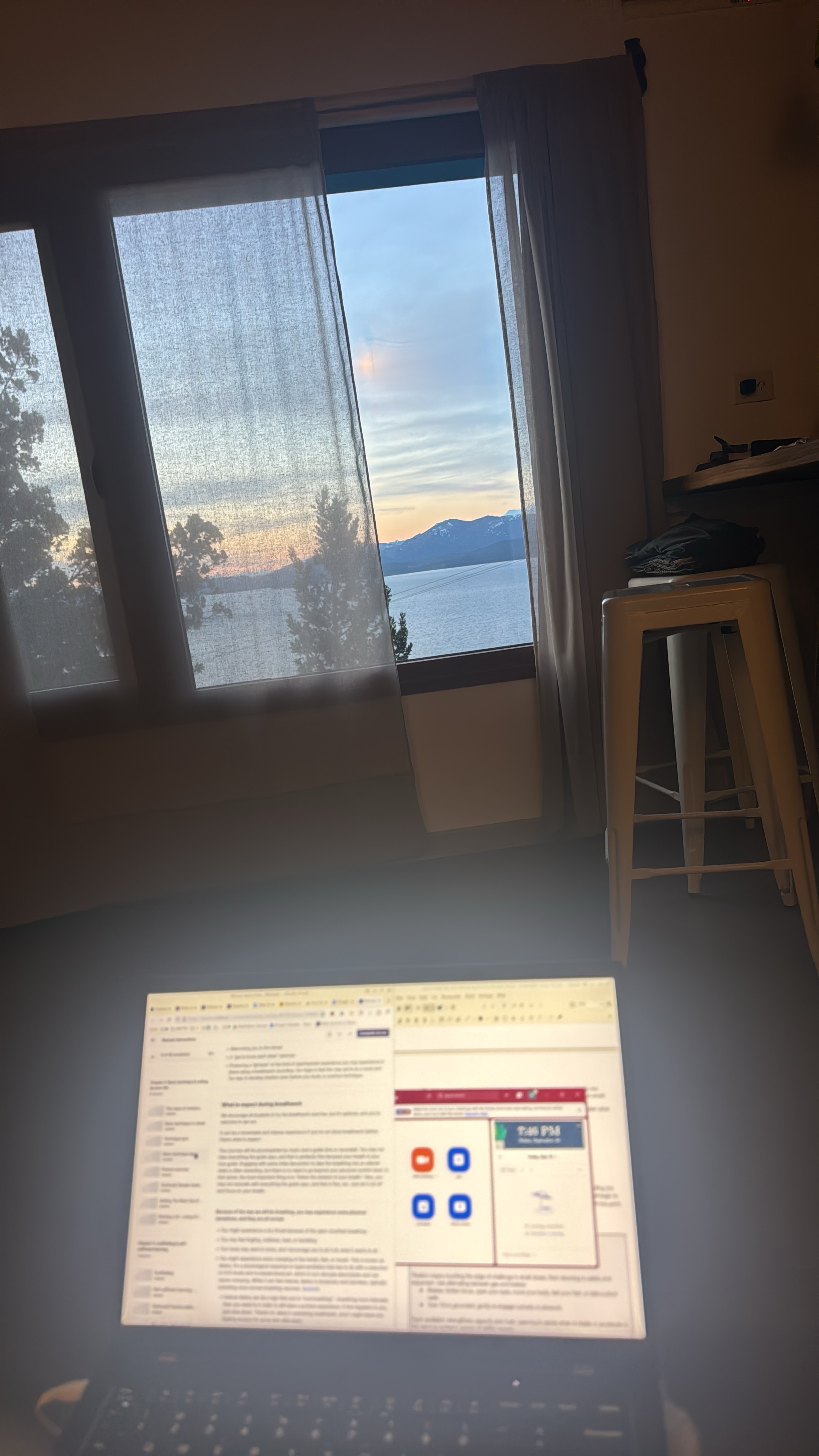
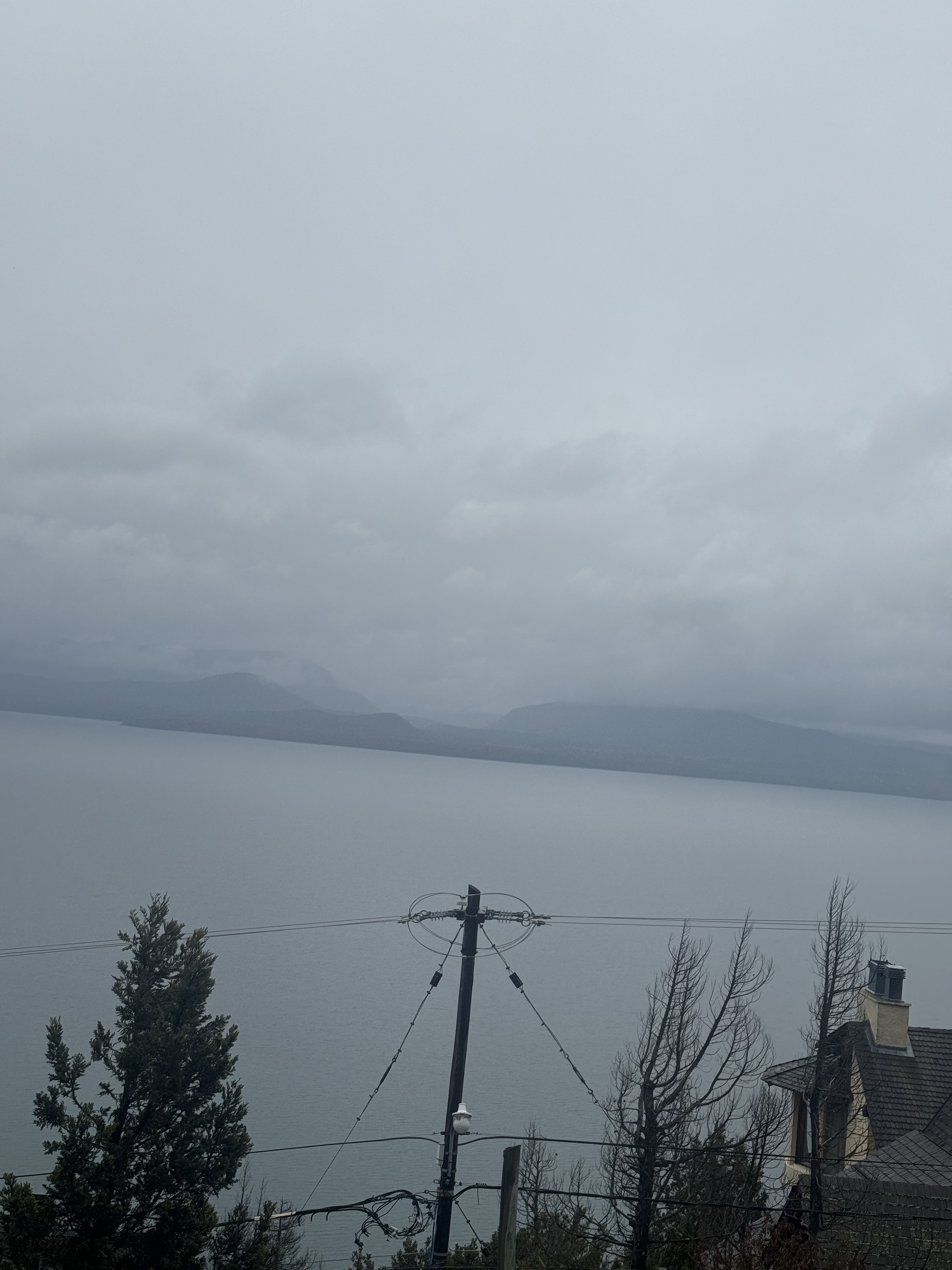
My physical setting did definitely help. Deep in Argentinian Patagonia, Nord’s referent be my window’s palette: deoxygenated autumnal foliage; the glacial silt shared by the ice-capp’d mountains and the base of the stolid chromium lake it there looms behind, not infrequently pervading over it all an atmosphere of condensation, obscuring any last mark of erosion or separation and thereby leaving behind only a glaucous multi-layered vector graphic silhouette of the range’s frontmost physical dimensions, peaks rising stepwise before fading into the misty background. E pluribus unum - is this not the essence of samatha meditation: out of the sensory milieu you keep in your mind a certain concept, an idea, congeal everything you see in the 5 outer sense-spheres into it, and become engrossed by it. That’s how the commentaries dryly describe it, anyways. This idea of things constantly “merging together” did seem to be a major theme in my practice, and the “interconnectedness”, dare I even say “oneness” of things, not to sound buzzwordy. Indeed, while some argue that samatha and vipassana are not a 1-dimensional axis but a graph of 2, my experience has started to lean towards the former, at least as a beginner meditator insight-wise. Things should deepen towards the latter over time though.
I can emphatically recommend Jhourney to meditators young and olde, beginner or advanced: hiding in a 2024 blog post from Stephen Zerfas (where he lays out his utopian vision, which I deeply share, of making advanced meditation and its states accessible to as many people as possible), they claim that “prior meditation experience is not correlated with success”. I can only assume he was going off the results of this blog post written less than 2 months earlier by a (seemingly world-class talented ) former retreatant which indeed concluded 2 things: “virtually no difference in success rates between experienced vs. beginner meditators” - albeit with a forgiving margin of error - and that “Experienced meditators are more likely to progress further with the jhanas when they succeed”.
So yeah, I don’t know. On one hand, this has been an amazing unlearning experience. For all the “mental moves” that might have been instrumental in navigating my experience, I do wonder how many got in the way, whether these be wrong ideas, or unconscious mental blockages. Any of those prior access concentration/jhanic experiences (including those on the retreat), insane psychedelic experiences of infinite space/consciousness and śūnyatā, etc., some ~2000 hours of mostly non-jhana-oriented meditation - while useful, perhaps I had to unlearn just as many things as I had to learn. Da steh ich nun, ich armer Tor! Und bin so klug als wie zuvor.
Would I go back in time and replace every second I spent on TMI in 2021 with Jhourney’s curriculum? Yes. But of course, the world was not quite ready yet. Now that I think about it, would I go back in time and replace the vast majority of those ~2000 hours with a “technique” of this style? Also yes. So yeah, maybe it would be better to have just learned from scratch, starting here! To think of all the negative reinforcement and self-defeating beliefs around the difficulty of these things I have accumulated… perhaps it is all a mirage.
As the Dao De Jing says:
When people are born they are supple and soft
When they die they are stiff and hard
What is full of life is lithe and moist and resilient
What is drained of it is brittle, withered, dry
The former are the marks of life
While the latter are the marks of death
If a soldier is stiff, whether with fear or pride, he will be defeated
If a tree is stiff, it will fall to the next wind
If you become stiff to raise yourself above others, you will fall
Let yourself fall, be supple and responsive, and you will be lifted
My “Experience”
So one of the first things I want to talk about is one of the first things that surprised me on one of the first nights: the idea that you can enter any of the 4 (possibly 8?) jhanas directly, as your first jhana experience. I had some idea about “jhana hopping” from the Visudhimagga and Contemplative Fitness, but I thought those were mastery techniques locked behind stream entry or something. Much less one’s first time in jhana. For the masses, jhanas are presented as these Matryoshka dolls where each subsequent one is ’encapsulated’ as a deepening of the one that precedes it. But the idea of accessing any of them right off the bat was pretty interesting5.
Sure, these are lite jhanas - this is an important disclaimer to make. These are not Visuddhimagga/Pa Auk jhanas where your entire body dissolves into white light or whatever by the time you reach access concentration. But still, why is the possibility of this not a well-known thing? It seems history is to blame6. Let’s think about it - they simply haven’t been taught with a technique like this. Breath meditation, even TWIM, from which Jhourney takes heavy inspiration, especially in their early days, kind of just coincidentally emphasize the factors of J1. They do not have this “open” technique at Jhourney where you can bring up an infinite range of openhearted emotions and allow them to grow. Some of them align more with J2, 3, or 4. Although a facilitator did say “maybe 90%?” of participants’ first jhana experience on their retreats is J1.
This realization certainly must have done something for me, since little did I know, I would experience this a mere 24 hours later on the night of day 2 when I seem to have entered the 4th jhana. Possibly the 3rd, but for the rest of this text, I’m just writing J4 for the sake of simplicity. My experience was roughly as follows:
For the morning 1-on-1 for Day 2, my facilitator asked me, like they always do, to tune into what I was experiencing in that moment. The beautiful scenery in which I found myself and the utter peace lended itself naturally to this feeling of “nothing-to-do-ness” or “suchness” that seemed to vaguely pervade everything. The “pleasure” (which hardly is a thing on the J4 strata of mind) was mostly an intellectual concept and not a bodily sensation, which is kind of a no-no regarding their technique of finding a distinctly bodily-emotional openhearted feeling. Nonetheless there did seem to be vague emotional peace, pleasure, or something, especially when I allowed a gentle smile to come into play. So I rolled with it for the rest of the day.
Later, I noted: day 2 on a Goenka retreat almost certainly wouldn’t feel like this. I wouldn’t say I’m “deep” at all, but I feel like I’m lining up a 1080 noscope trickshot into a very powerful attractor basin that I could pop into any moment. Kinda like Frank Yang’s analogy of the last sit being like sitting inside a self-driving spaceship he spent the whole retreat constructing.7
Then came the evening sit. A very chill and cozy guided meditation. Here’s what I wrote in my daily journal after the sit: Eventually, I got kind of fessed up with the whole “scaffolding -> openhearted feeling” thing and I wished it were just one thing rather than feeling peaceful -> waiting for mental appreciation -> noticing the appreciation. This feeling of peace - isn’t that enough, I thought? Then I had this weird idea in my head to “become” both, or “become” the openhearted feeling? That’s just what my inner monologue said I guess. Soon after, I realized it was taking a lot of mental effort to kind of maintain this attention on the tension in my head (that seems to be where a lot of my sensations were lying - first, by relaxing by trying to make my mind as wide as the sky, and then, this feeling of sharing it with all beings by seemingly emanating it from there, and then, that just seems to be where this kinda intellectual/mental “okayness” lives for me) and I realized it would be a lot better if I didn’t have this attentional anchor/tension thing going on and that I should try and focus more on the okayness itself on a more direct level. The constant advice Jhourney gives about reducing effort (maybe they even said it in the guided meditation) came to mind, but I thought to myself “but I’m scared… this “okayness” (or whatever) is right here in my head; I’m scared it might disappear like usual if I drop my effort… I’ve worked hard to get here” and then I thought to myself “but isn’t there nothing to do anyways? It’s okay……” (i.e. isn’t the lack of need for any effort-ing and striving the exact feeling I’m trying to tap into?) and immediately it felt like I closed some kind of loop. Then, I entered and remained for about 15 seconds in what I am highly confident is jhana (J4?) territory.
The mental absorption was pretty unmistakeable, having been in access concentration a few times over the years. But there were no piti/champagne bubble sensations whatsoever. My body felt like it was made of heavy silicone or something, with this “pulsing” effect all throughout, while at the same time feeling tranquilized; my bodily sense was dissolving, especially the areas outside the head (I seem to associate some kind of scalp tension with a lot of mental “anchors”). The primary mental characteristic was precisely this “non-effort”/”non-doing” thing I took as my scaffolding where it didn’t ever feel ecstatic… I would barely call it soothing; it just felt like… “the only thing there is to do” in a way, or “the only way there is to truly relax/rest”. It certainly wasn’t negative but I’m really grasping at straws trying to describe what made it positive, which it certainly was. It was brief - and a bit liminal - but I dare say it wasn’t really even relaxing. I was kind of just existing, almost like an inanimate object.
Naturally, my heart was absolutely pounding in surprise. I attempted to analyze my experience right then and there in hopes of finding out how I might return, rather than coming out of it like “wtf just happened?” This analytical, abhidhammic attitude persisted for a few days, being utterly perplexed at how that just happened.
Not coincidentally, I should think - things “happening” for me in the retreat largely de-escalated from there. I had a pretty detailed conversation with Claude about navigating back to J4 territory and how it intersects with this idea of an openhearted feeling and things like that, but in retrospect, all those notes are garbage compared to the unpunctuated and uncapitalized optimistic afterglow-fueled reports from my own lived experiences.
There I was, proud indeed - attached to my affinity with the sublime state of equanimity which characterizes J4. It’s #4 for a reason, after all. Even 5-8 possess the same underlying mental factors, just with different objects of attention and a greater state of ‘defabrication’. I felt validated - like I’ve stated earlier, Jhourney has a bit of a metta/forgiveness/gratitude-oriented lineage. (In one guided meditation, they joked that they sometimes jokingly consider dropping all the instructions and just replacing it with forgiveness). Many of the instructions given, including the example “scaffoldings” they give you, as mentioned earlier—mantras to wish people well, happy memories, etc.—are intended to create feelings of what is usually happiness (as stated, characteristic of J1) or something adjacent on the emotional spectrum - it doesn’t matter what exactly, as long as it’s wholesome, and/or, as Jhourney says, “openhearted”.
Yet, I hardly felt any of this. I gave TWIM (a popular framework of mettā/loving-kindness meditation) an honest try years back, but the mantras were just totally mechanical. There was no visceral, physical feeling of love, no anything. Even Rob Burbea-style ’energy body’ breathing didn’t really “do” anything for me. And so, here I was now, seemingly bypassing the need for all of that! Ah yes, I thought! I’m simply above such terrestrial emotions as rapture, happiness, joy, and bliss, which are abandoned on the way from J1 to the higher jhanas; peace and equanimity is a more refined and subtle state. Let us continue this, I thought.
Rather than Claude’s answer about what I could do (which almost exactly corresponded to Shinzen Young’s Focus on Rest (1, 2) technique), in reality I had a much better answer from one of the facilitators when I asked about “tuning in” to certain jhanas, but namely J4 for my case: simply trust whatever ‘attractor basin’ your nervous system is primed towards and don’t worry about where you’re going or really plan on going anywhere specific. It’s all part of just accepting any and all experience. You’re not going to get to jhana if you neglect that step, anyways.
I realized that yes indeed, during a Jhourneying session on maybe day 3 or 4, I started with this very blissful feeling of white-yellow light permeating throughout my body after being asked to appreciate this feeling of optimism I started the sit with. But then, within 15-20 minutes, I naturally went right back to noticing the J3/4 relief/contentment quality despite the very blissful, sukha-filled opening to the sit. I didn’t really have to try for it to go that way; that’s just how my nervous system is wired. And if it were wired in the exact opposite way, that would be perfectly okay too.
Letting things gravitate towards their natural state and thereby blossom into something amazing simply with awareness and love all the way down is one of the key mottos for the entire retreat really, and only gradually do you realize how true it is, as you navigate more and more mental strata as you start each day, each sit, each moment anew - for no man steps in the same river twice.
For these reasons, I have spared you the more personal details and small shifts, which are very important in their own right, just not 100% worth sharing with people who have not lived your life and do not think with your mind or embody your body. (And, well, there’s just the fact that some of these mental shifts are context-dependent, subconscious, hard to find the right words for, etc. etc.)
As Rob Burbea says in Seeing that Frees, p. 39:
"[L]et us rather view [samādhi] mostly as a continuum: of depth of meditation, of well-being, of non-entanglement, and of refinement of consciousness. Among other benefits suitable to our purpose, there is also less chance then that the relationship with practice becomes fraught through wondering too much if one ‘has it’ or ‘doesn’t have it’, is ‘succeeding’ or ‘failing’, is ‘in’ or ‘out’. Instead of relating to samādhi practice in terms of measurement or achievement of some goal, it is usually much more helpful, more kind, and less self-alienating to conceive of it as a caring, both in the present and in the long term, for the heart and mind.”
-
For an interesting visualization of all 8 jhanas, I like Roger Thisdell’s video ↩︎
-
For a more modern perspective, see also an AI illustration made by Andres Gomez Emilsson based on his post Buddhist Annealing: Wireheading Done Right with the Seven Factors of Awakening. When I say ‘mental factors’, that can either mean the underlying mental qualities of each jhana, or the factors of awakening that are necessary for them to arise in the first place. ↩︎
-
This idea of re-experiencing and re-contextualizing past memories explicitly a part of the second half of the curriculum. I can only assume this would be a really significant component of the retreat for the crowd that routinely responds really well to all these things like forgiveness, mettā, etc.. ↩︎
-
In my estimation, it must have shed a lot of its “techy” or “nerdy” flavor for the most part, if it was ever there? I was expecting the staff to be caffeinated programmer types rather than the more familiar type of super-chill meditation coaches due to their marketing and the press around Jhourney. I am receptive to SF rationalist lingo or whatever and am no fan. The (lengthy!) written instructions do have a “voice” of sorts, but it’s really quite neutral and has mass appeal. The YouTube videos are in the same voice, which I find comforting and sincere, really. ↩︎
-
To be technical for a moment, with regard to the ‘basis’ all this, I return of the concept of the ‘vipassana jhanas’ and the Bill Hamilton-related view that these are merely scale-invariant ‘strata of mind’ which therefore don’t necessitate ‘abiding’ in them when we consider the (also Visuddhimaggic) concept of momentary concentration. ↩︎
-
As they lay out in their Why There Are Two Definitions of Jhana blog post (which I mentioned also in my last blog post), the modern world of jhana is surprisingly brief and has only in recent decades loosened its standards back towards the emphatic glory days of the Pali canon. If we’re to trust the truth of these stories from the Pali Canon- people attaining paths after merely hearing a discourse, people entering jhana in a similarly straightforward way - one would like to think that these insights simply were (and therefore are) just ways of looking, not things which necessitated “working” long and hard. The Visuddhimagga is an epic text, but they probably went a little too far with the jhana stuff and their conception of them is pretty patently apocryphal compared to what is described in the suttas.
(If you don’t know why I’m rambling about all this, it’s a bit of a hotly debated topic at times in the (online) dharma community, cf: https://www.rogerthisdell.com/post/throwing-my-hat-in-the-jhana-ring) ↩︎