When I set upon my journey to deep dive on researching neuroscience as a non-academic perennial outsider, achieving human superintelligence was basically the main goal of mine. I wasn’t really interested in personal gain and ‘productivity’. I was born in 2002 and considered my stake in the future relatively secure as long as my decisionmaking healthwise was just slightly sane; I would say I have been ‘fully AGIpilled’ since around 2021, coinciding with an interest in longevity (escape velocity). These 2 concepts and their intimate relationship osmosed into my subconscious due to watching all of Kill(ss)ing Asuka’s videos and a cursory reading of the Lesswrong sequences and other things in that memeplex. The inevitability of trans-/post-humanism was revealed to my by 2001: A Space Odyssey some years prior. One must think about the course of civilization entelechically; from the endpoint retroactively. In a posthuman civilization - would they not have outsourced cognition to supercomputers or other post-natural selection (i.e. scientifically augmented) modalities? As of today, we can see that integration with tech like BCI will eventually replace the blackbox “terminal” model of current LLMs and agent orchestration, but I digress.
So from the beginning, I did often question what this biological and neuroscientific journey was even for in an imminently post-AGI world beyond pure mental masturbation in order to pass the time. My best argument for this has been that ideally it would facilitate some semblance of ‘alignment’ where a high-IQ populace would perhaps surpass certain theoretical cognitive local minima (it is easy to conceptualize their emergence in complex ethical dilemmas, andor other such metacognitively demanding quandries) - or at least, arbitrarily ’the smarter the better’. The intersection with the science of enlightenment is also highly pertinent due to the much-needed ‘human touch’ of consciousness research, seeing as AIs on the von Neumann architecture cannot be, and will never be, conscious or sentient.
I think of my posts like Gene Therapy for Color Vision. It was a very fun week researching all the different subtopics involved in solving this problem (and countless other such lines of inquiry I had been privately engaging in on the quest for human superintelligence and the science of enlightenment). As I described by ‘the funnel’ in my post on SRS, it’s an infinitely rewarding process studying with the certainty that memory is a choice; being certain you will remember certain pieces of information for which you take the time to craft flashcards. With enough consistency, you could have large swaths of scientific fields at your memory’s beck and call, which would thereby provide the necessary foundation for particularly advanced lines of inquiry and for spontaneous insights alike. Together with Nootropics, it’s a program fit to make even a typically unremarkable mind occasionally quite deadly indeed. Well, after a 3 month meditation retreat in 2024, I have stopped using Anki (iykyk - review hell) for such things as biology, IT, etc.. As of right now, I only use SRS for retaining Mandarin Chinese vocabulary. For those of you who read the notes section of this blog, you might have noticed a steep decline in the amount of new notes edited/created past late 2024 compared to the golden years of 2021-2023.
I’m afraid it was all too late, anyways.
Is it not all largely obsoleted by LLMs? In the recently viral The Dark Night of Mathematics, does he not speak for virtually all knowledge workers? I can only assume the topic of ‘LLMs are to thinking what calculators are to arithmetic’ is a topic that has been deeply discussed, but yes: ever since the release of ChatGPT, that has, unfortunately, been the position I’ve securely kept. What are we who derive our highest known worldly pleasure from thinking about interesting problems to do? The joy of asking myself, or answering for others, questions that can be answered in increasingly perfect accuracy by an LLM, is all but gone, honestly. Why learn things without some explicit pragmatic goal at this point?
What are we to do? I shall circle back - contemplative science is the final frontier. If über-jhourney goes public they deserve be a >$1T market cap company, but I digress - not here to shill. The next post on this site will probably be a part 2 of the topics covered in the science of enlightenment blog post, synthesizing what I have gathered over the past couple years (and probably the next year). In these past 3 years since I laid out all my rough ideas in that post, people have written some pretty interesting papers. I hope to present a slightly better working model, directions humans trials should go in, and also make a solid phenomenological case for what ’the best techniques’ are for achieving insight/progress on the path (fire kasina is still the best contender). It’s quite whitepilling that pragmatic dharma is actually quite a novel field; Jhourney’s blog post Why There Are Two Definitions of Jhana provides a good history on the matter. Anyways: can AI build the philosopher’s stone; the enlightenment button? It will still require human intervention for quite a while, as far as I can tell. Is it even possible? Time will tell.
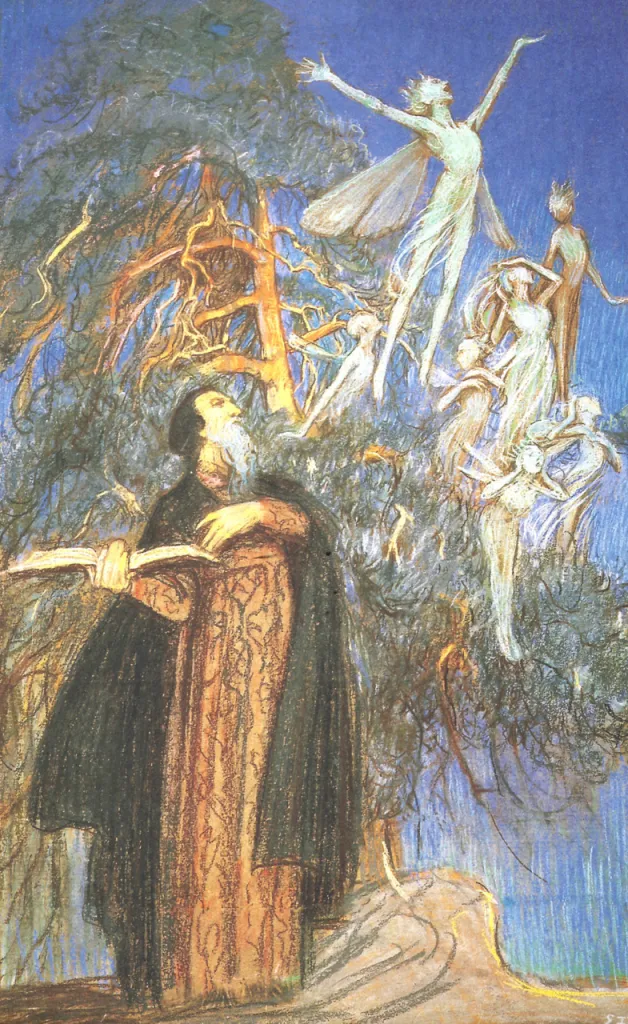
Weak masters though ye be—I have bedimm’d
The noontide sun, call’d forth the mutinous winds,
And ’twixt the green sea and the azured vault
Set roaring war: to the dread rattling thunder
Have I given fire, and rifted Jove’s stout oak
With his own bolt; the strong-based promontory
Have I made shake, and by the spurs pluck’d up
The pine and cedar: graves at my command
Have waked their sleepers, oped, and let ’em forth
By my so potent art. But this rough magic
I here abjure; and, when I have required
Some heavenly music,—which even now I do,—
To work mine end upon their senses, that
This airy charm is for, I’ll break my staff,
Bury it certain fathoms in the earth,
And deeper than did ever plummet sound
I’ll drown my book.